Configuring for an Independent Analysis
To configure the analysis rule, follow the steps below using either PI System Explorer or the ProcessBook SF Modeler.
Follow the steps under either System Explorer or Modeler.
In the Model Analyses navigation pane, go to the Model for which you are creating the analysis.
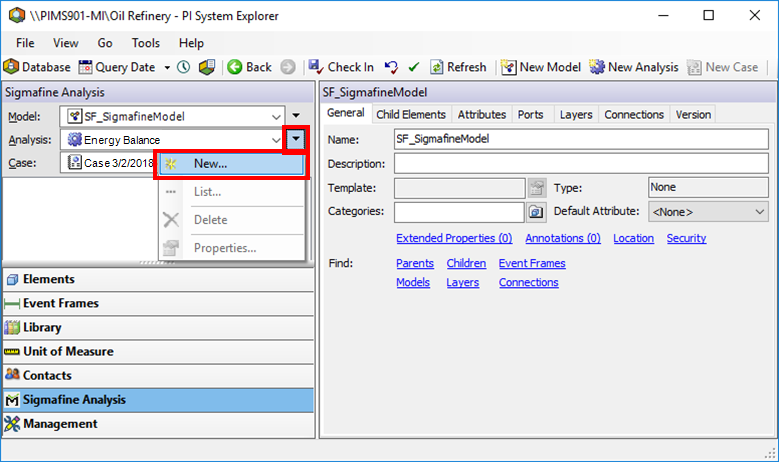
Click the Analysis
 menu button and select New from the menu, to open the Choose Analysis Template window.
 System Explorer
- On the SF Analysis Toolbar, click the New Analysis button to open the Choose Analysis Template window.

The following steps are common to both System Explorer and ProcessBook (Modeler) configurations.
In the Choose Analysis Template window, \<None> is selected by default; this value is fine for what you need to do.
Click OK.
The Analysis Properties window opens.
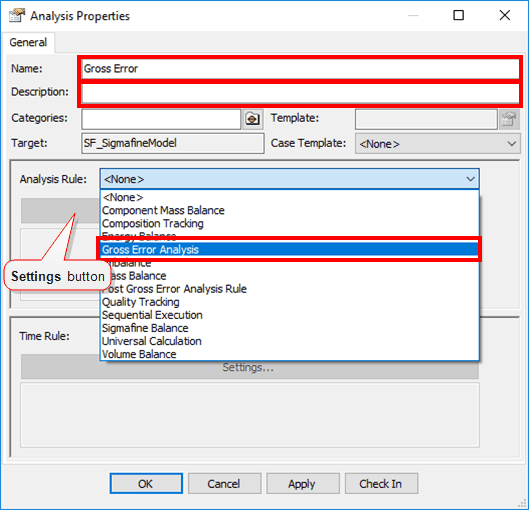
In the Name box, type a name for the new analysis.
(Optional) In the Description box, type a short description of the analysis.
Click the Analysis Rule down-arrow and select Gross Error Analysis.
Under Analysis Rule, click the Settings button.
The Gross Error Configuration window opens.
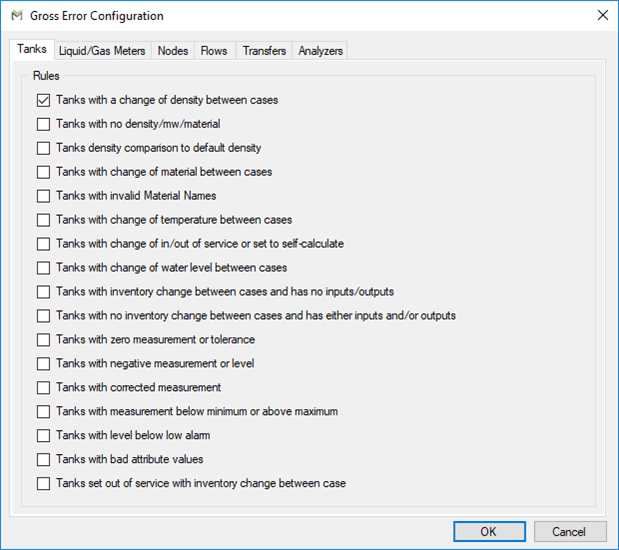
Based on the objects to validate, select the rule to configure (in our example, we selected "Tanks with a change of density" between cases.).
A second window opens in which you select Attribute names and rule settings.

The properties and options for each rule are described later in Tanks with a Change of Density Between Cases.
Configure the rule and click OK.
After a rule has been configured, the text "CONFIGURED" appears after the entry as shown in the following figure.
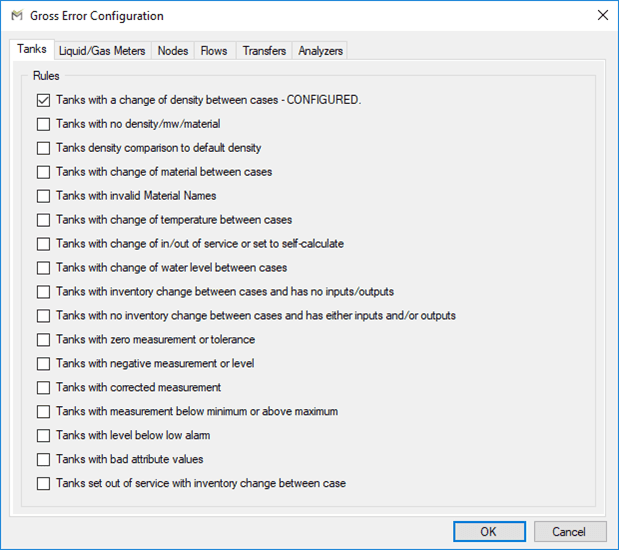
You can configure another rule by checking the checkbox by the rule name. Otherwise, click OK.
The Analysis is now configured. To create a Case for this analysis, see Running the General Gross Error Analysis.